


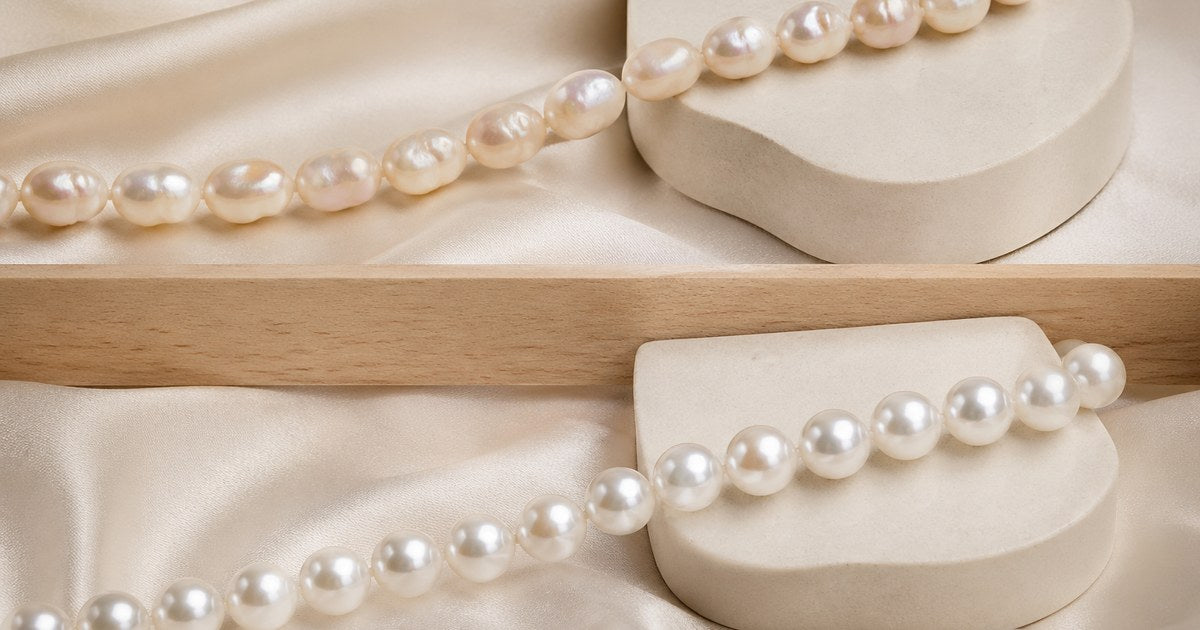
Freshwater vs. Saltwater Pearls: A Complete Guide
If you've ever stood in front of a pearl jewelry display feeling slightly overwhelmed — freshwater, Akoya, South Sea, Tahitian, Edison — you're not alone. Pearl terminology has a way of multiplying. But the differences are actually quite logical once you understand the underlying biology, and knowing them will help you choose with confidence rather than guessing.
This guide covers everything: where each type comes from, what makes them look and feel different, what they cost, and which one is right for you.
The Two Worlds: Freshwater and Saltwater Defined
All cultured pearls are grown by inserting a small irritant into a living mollusk and allowing the animal to coat it with nacre — the crystalline protein that gives pearls their glow. The difference between freshwater and saltwater pearls starts with the host animal and the water it lives in.
Freshwater pearls are grown in mussels living in lakes, rivers, and ponds, primarily in China, which produces the vast majority of the world's freshwater pearl supply. A single freshwater mussel can host multiple pearls simultaneously — sometimes 20 to 30 at once — which is one reason freshwater pearls tend to be more affordable than their saltwater counterparts.
Saltwater pearls are grown in oysters living in the ocean, in carefully managed marine farms. Each oyster typically produces only one pearl per harvest. The three main types of saltwater pearls are:
- Akoya pearls — grown in Japan and China in the Pinctada fucata oyster; the classic round white pearl most people picture when they hear "pearl necklace"
- Tahitian pearls — grown in French Polynesia in the black-lipped oyster; naturally dark-colored, ranging from charcoal to peacock green
- South Sea pearls — grown in Australia, Indonesia, and the Philippines in the large Pinctada maxima oyster; the largest and most valuable type, in white/silver or warm golden tones
There is also a newer category worth knowing: Edison pearls, a specialized variety of large freshwater pearl developed in China using a different nucleation technique that produces unusually large, round, high-luster pearls — often rivaling or exceeding the quality of Akoya at a much more accessible price point.
Origin and Cultivation Time
The time it takes to grow a pearl significantly affects both its quality and its price.
Freshwater pearls take between 2 and 7 years to grow. Because the irritant used in freshwater cultivation is typically a small piece of mantle tissue (rather than a bead nucleus), the resulting pearl is made almost entirely of solid nacre. This solid-nacre structure is actually one of freshwater pearls' underrated strengths.
Akoya pearls take 1 to 2 years to grow. They are nucleated with a round bead made from Mississippi River mussel shell, which is why they are so reliably round. The nacre layer is thinner than in freshwater pearls — often 0.35 to 0.7mm — but the quality of the nacre surface on a top-grade Akoya is exceptionally fine.
Tahitian pearls take 18 months to 2 years, and South Sea pearls take 2 to 4 years. Both types have thicker nacre than Akoya, which contributes to their notably deep, satiny luster. Edison pearls take 3 to 5 years, and their cultivation technique involves a round bead nucleus — similar to saltwater pearls — which gives them their characteristic roundness.
Luster, Shape, and Color Comparison
Luster — that inner glow, the way a pearl seems to light up from within — is the most important quality factor in any pearl. It comes from the depth and quality of the nacre layers, and how light reflects and refracts through them.
Freshwater pearls: Good to very good luster; solid nacre means they resist chipping well, though surface luster is typically slightly softer than the best Akoya.
Akoya pearls: Excellent to exceptional; their dense, fine-crystalline nacre produces the sharpest mirror-like reflections of any pearl type — this is the "classic pearl look."
Tahitian pearls: Excellent; their thick nacre gives them a deep, complex luster with visible overtones.
South Sea pearls: Excellent; described as "satiny" or "velvety" — less mirror-sharp than Akoya but with extraordinary depth.
Edison pearls: Very good to excellent; significantly better luster than standard freshwater, often approaching Akoya quality.
Baroque and irregular-shaped pearls deserve a note: they are having a strong moment in 2026. Their organic, sculptural shapes are genuinely beautiful and often display spectacular luster, since luster depends on nacre quality, not shape. Don't overlook baroque freshwater pearls if you're drawn to more expressive, artistic jewelry.
Price Range: What to Expect
Freshwater pearls are the most accessible. Standard freshwater pearl jewelry ranges from affordable everyday pieces to several hundred dollars for high-quality strands. They represent outstanding value.
Edison pearls, because of their size (typically 10–16mm), longer cultivation time, and superior quality, sit at a higher price point than standard freshwater — often comparable to or slightly below entry-level Akoya.
Akoya pearls typically range from a few hundred dollars for small (6–7mm) strands to several thousand for longer, larger, perfectly matched Hanadama-grade necklaces.
Tahitian pearls range from a few hundred dollars per pearl for smaller, lower-grade pieces to thousands for large, high-luster, round specimens.
South Sea pearls are the most expensive type. Quality South Sea strands regularly sell for tens of thousands of dollars.
Comparison at a Glance
Here's how the main pearl types compare across the key factors buyers care about most:
Freshwater: Solid nacre | 5–12mm | Baroque to round | Good–very good luster | White, pink, lavender | 2–7 years cultivation | Most affordable
Edison (Freshwater): Bead-nucleated | 10–16mm | Round to near-round | Very good–excellent luster | White, pink, lavender with metallic sheen | 3–5 years | Mid-range
Akoya: Bead-nucleated | 6–9mm | Round | Excellent luster | White, cream | 1–2 years | Mid to high
Tahitian: Bead-nucleated | 8–18mm | Baroque to round | Excellent luster | Black, grey, green, peacock | 18 months–2 years | High
South Sea: Bead-nucleated | 10–20mm | Round to drop | Excellent luster | White, gold | 2–4 years | Luxury
Quick Decision Guide: Which Pearl Should You Choose?
If you want classic, timeless elegance — Akoya pearls are the benchmark. Their mirror-bright luster and reliable roundness are why they've been the pearl world's standard for over a century.
If you want exceptional value without compromising on beauty — freshwater pearls, and especially Edison pearls for larger statement pieces, offer extraordinary quality at accessible prices. Modern freshwater pearls are a genuinely smart choice.
If you're drawn to color and individuality — Tahitian pearls are in a category of their own. No other pearl produces that natural peacock-green or deep charcoal naturally.
If you're building an heirloom — South Sea pearls represent the pinnacle of the pearl world for a once-in-a-lifetime piece.
If you love the organic, sculptural aesthetic of 2026 jewelry trends — baroque freshwater or keshi pearls are having a well-deserved cultural moment. Their irregular shapes and spectacular surface luster make them genuinely extraordinary.
At JNOE Jewelry, our collection focuses on high-quality freshwater and Edison pearls — chosen because they deliver exceptional beauty, excellent durability, and outstanding value. Every pearl we use is selected for luster first.
Read more
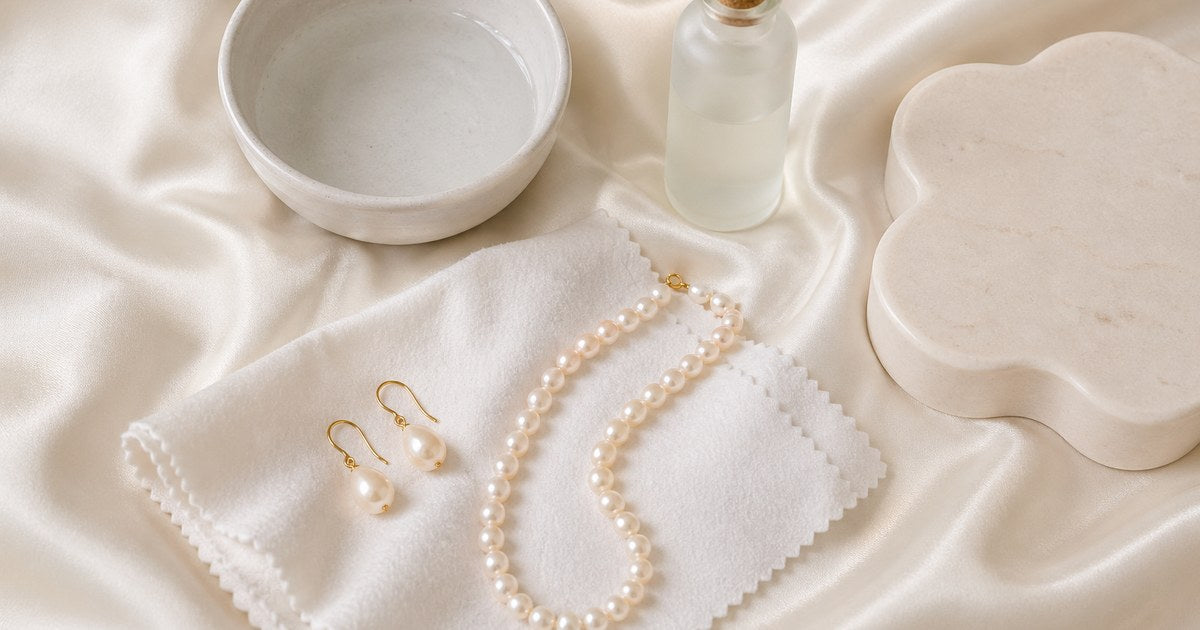
How to Care for Your Pearl Jewelry: A Complete Guide
Pearls are living gems — and they repay a little attention with a lifetime of beauty. Here's everything you need to know to keep your JNOE pearls luminous for decades.
Read more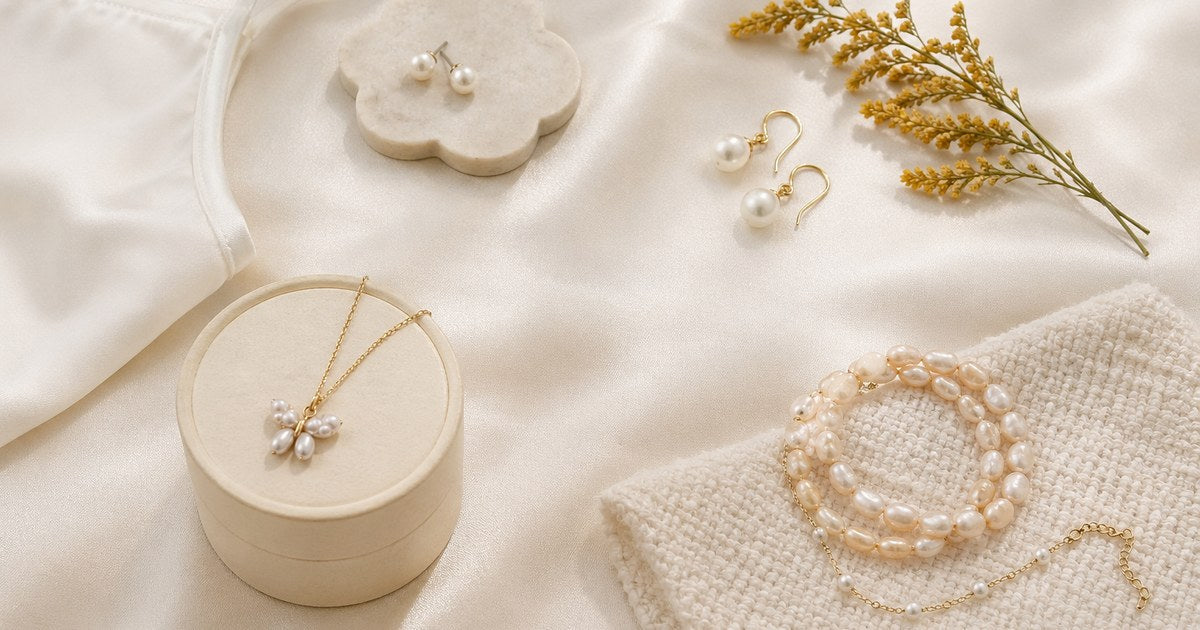
The Best Pearl Jewelry for Every Occasion
There's a persistent myth about pearls — that they belong only to formal events, that they're "too classic" for everyday life, that pulling them out means you've dressed up. It's understandable how...
Read more